Solutions · Auto parts
Your auto parts shop — with vehicle fitment for every part.
Every part answers one question: does it fit my car? Made for used parts first — recyclers and used-parts dealers with catalogues of ten thousand to a million articles, where a wrong answer becomes a return. The shop is built around the answer — the vehicle register, the donor car, the part record and the feeds that keep all three current.
Everything on the online shop page is included here. Online shop →
Admin · Vehicles
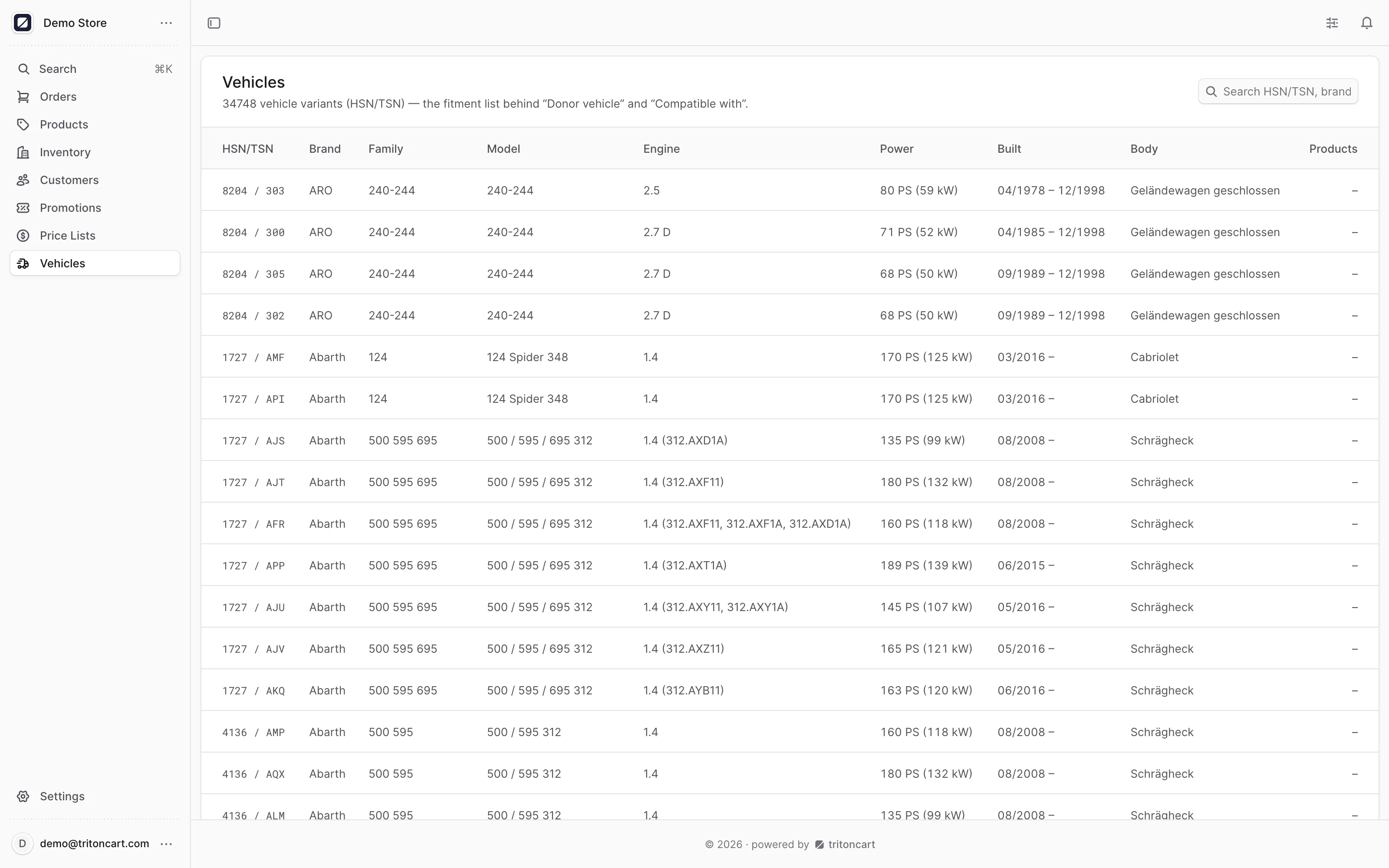
Fitment
The German type-approval register, in the shop.
- 34,748 variants
- Every HSN/TSN variant with engine, power, build years and body — searchable, and each row knows how many of your articles fit it.
- One code, several cars
- A type approval can cover several models. The register says so, and the shop resolves a part to every variant of its code instead of guessing one.
- Two ways in
- The papers (HSN/TSN) for people who have them, brand → model → engine for everyone else. Both land on the same filter.
The part record
A used part is not a product with a stock level.
It exists once, it came out of one specific car, and it carries the numbers a buyer cross-checks before ordering. The record holds all of that — and the shop reads the description out of it rather than storing a text somebody has to maintain.
- Quantity one
- One part, one sale. Stock is not a number that counts down, it is a row that disappears.
- Donor and compatibles
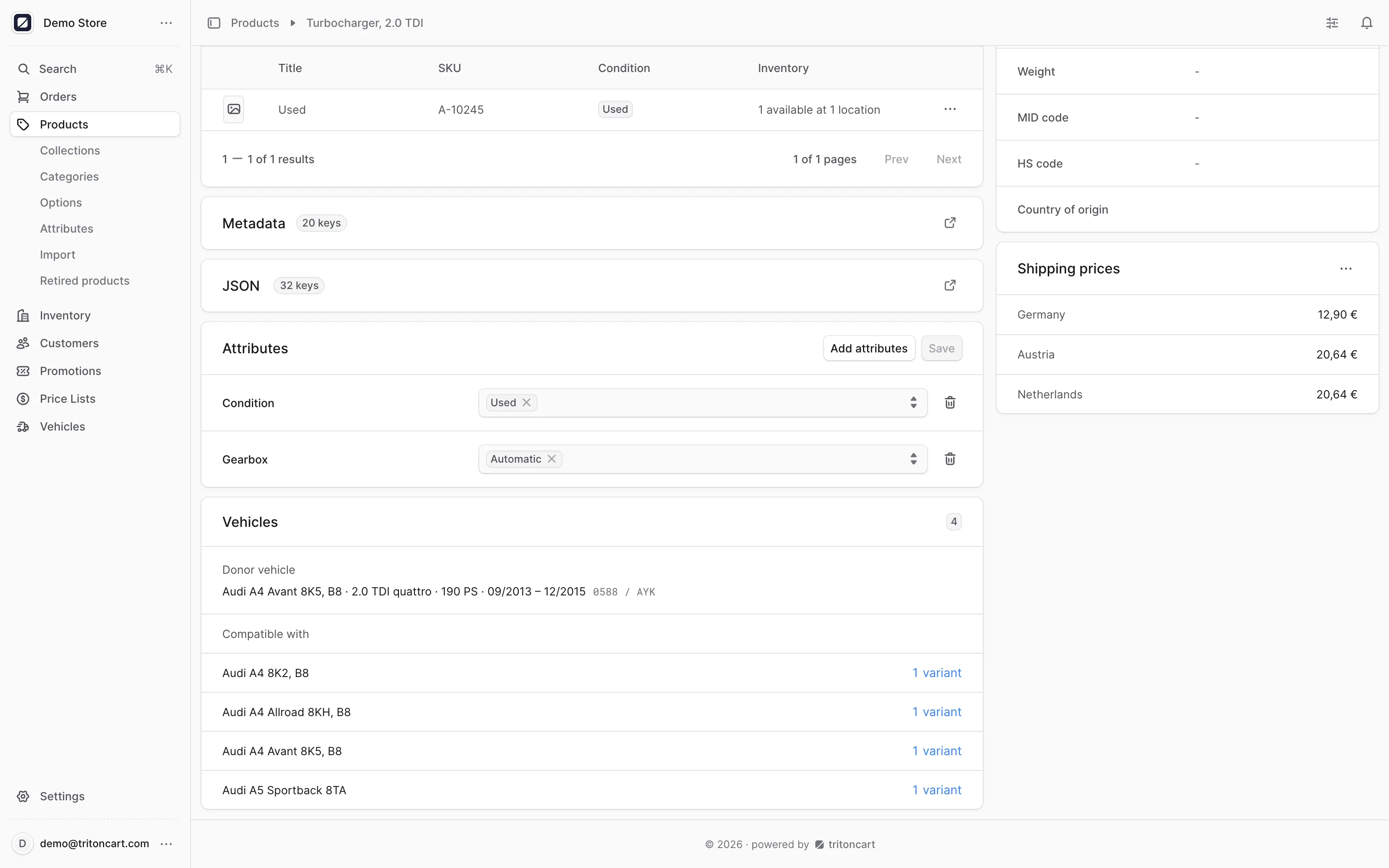
- The car it was removed from, and every vehicle its codes resolve to — written by the import, never typed.
- The numbers buyers check
- OE and reference numbers, condition, fitting position, damage note.
- Its own shipping price
- A bumper and a sensor do not ship alike, so the price sits on the part, per country.
Admin · A used part
Supplier feeds
The catalogue keeps itself.
A parts warehouse changes every day: parts come in, parts sell, prices move. The shop takes that as files on a schedule and reconciles itself against them — nobody edits a catalogue of that size by hand.
- 02:00PhotosNew pictures land in your own storage over SFTP.
- 04:00Stock filesAdditions and removals for the day, plus the full master to reconcile against.
- 04:15Import runCreated, updated, retired — with a report, and nothing silently dropped.
- 04:20LiveSearch, filters and web-sized images rebuilt; the old pages purged.
Sold-out parts retire on a grace period and come back if they return. A master file never deletes what it does not mention.
Photos at scale
Hundreds of thousands of pictures, none of them resized by hand.
Used parts are sold on their photographs, and a recycler produces them by the thousand. You upload the originals once; everything after that is the platform: web variants in three sizes, WebP, srcset, an optional watermark, delivery from a CDN, deletions that follow the part. On the first installation: 480,000 originals and 1.4 million web images.
The original is the fallback: a variant that is missing never leaves an empty tile.
- 01Upload once
- SFTP into your own bucket — no portal, no manual import.
- 02Three sizes
- Every original becomes 320, 800 and 1600 px WebP.
- 03Daily top-up
- New photos are picked up with the night run.
- 04Served from the edge
- A CDN in front, purged when a picture changes.
The garage
The visitor tells you the car once.
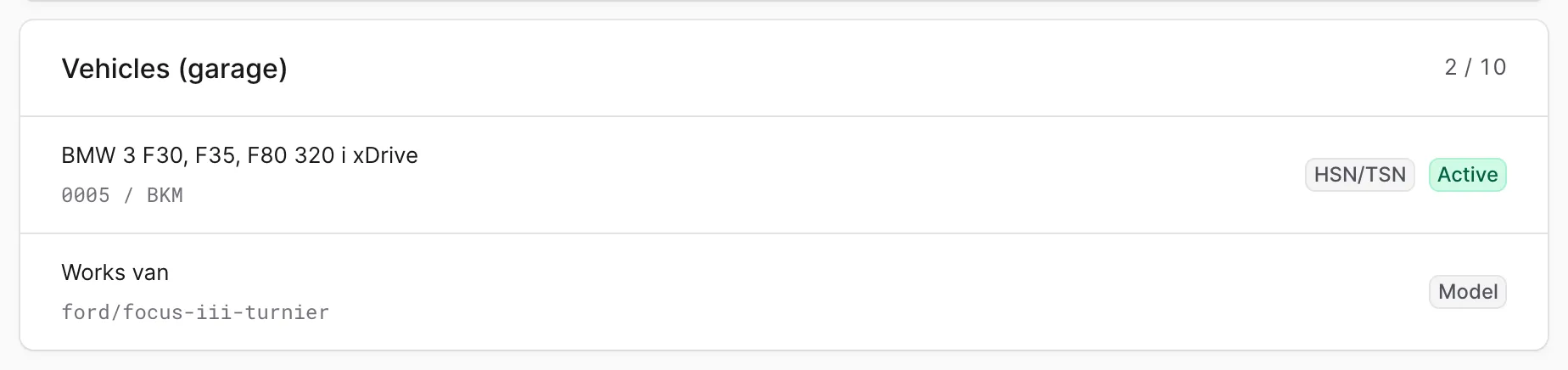
Admin · The customer’s garage
- Kept across visits
- Saved in the browser for a guest, merged into the account at login. Every listing, every product page and the search filter follow the active car.
- More than one car
- The household car, the works van, the project — one is active, switching takes a click.
- Visible to support
- When a customer calls, the operator sees which car the shop was filtering by. That is usually the whole conversation.
A vertical, not a fork
The same platform, with the parts modules switched on.
Vehicles, fitment and the garage are modules of the one platform — installed everywhere, switched on for the shops that sell parts. A furniture shop never sees them; a parts shop gets every platform improvement at the same time as everybody else.
Admin · Modules
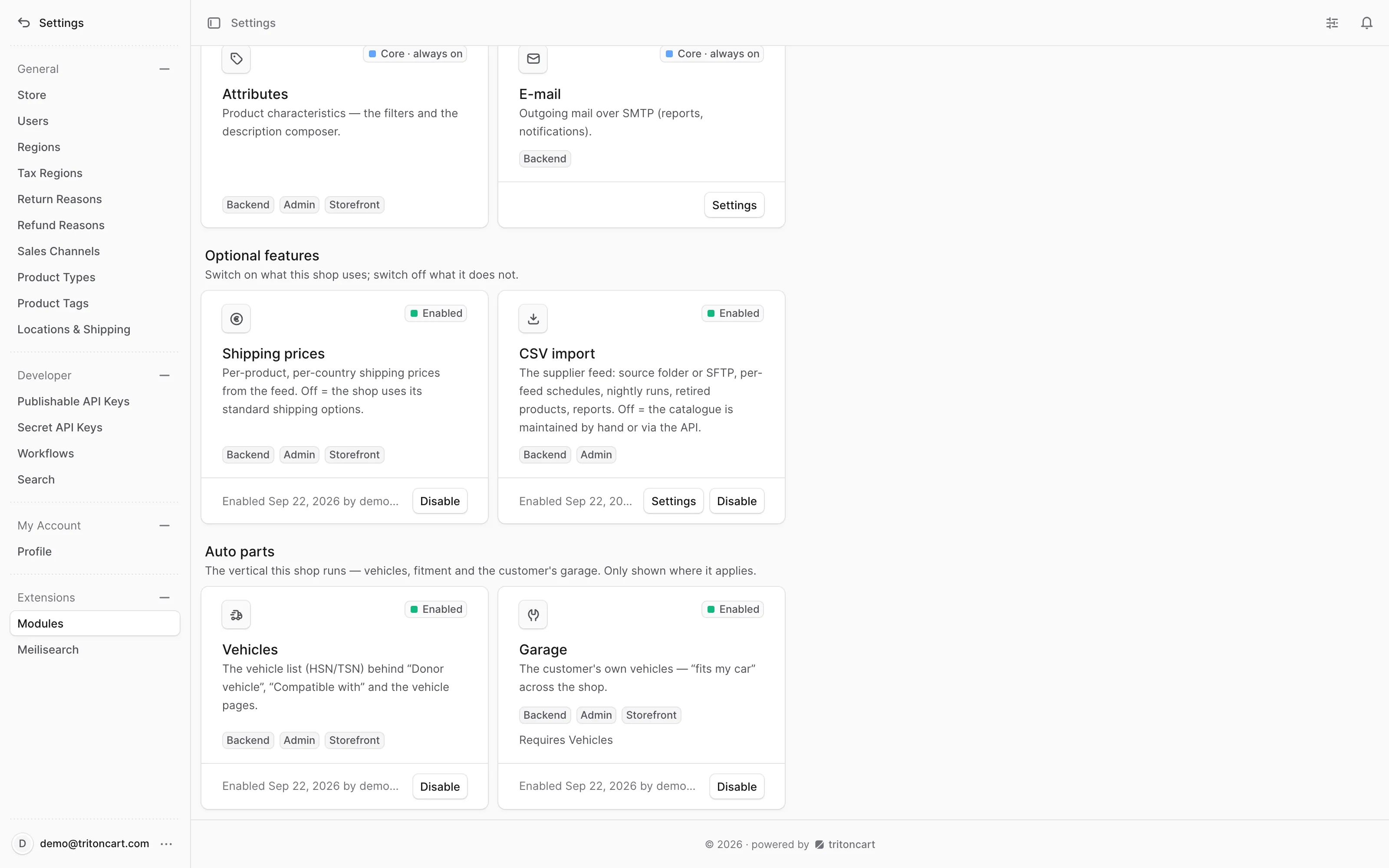
No customer runs a private version of the software. That is why there is anything to switch on.
What we do not claim
Built, and not yet built.
Not built yet
- TecDoc linkage — the parts catalogue standard. Planned, not connected.
- Marketplace export (eBay and friends) — planned, not connected.
- An English or second-language parts storefront — the vertical ships German first.
- Wheels and tyres by size, with the EU tyre label — planned.
The first installation goes live in autumn 2026.
A parts dealer with a six-figure catalogue, daily supplier files and a photo archive of that size. Until it is live there is no case study here — the screens on this page are our own demo install, not somebody’s shop.
Other solutions
Questions
Frequently asked.
How does vehicle fitment work in the shop?
The shop carries the German type-approval register: 34,748 HSN/TSN variants with engine, power, build years and body. Each part is linked to its donor car and to every vehicle its codes resolve to — written by the import, never typed. Customers find their car by HSN/TSN from the vehicle papers, or by brand, model and engine, and keep it in their garage across visits.
Can the shop take daily stock files from my warehouse or suppliers?
Yes. Stock files and photos arrive on a schedule over SFTP; every night the shop reconciles itself against them — parts created, updated or retired, with a report and nothing silently dropped — then rebuilds search and web images. Sold-out parts retire on a grace period and come back if they return.
Is TecDoc supported?
Not yet. TecDoc linkage is planned, not connected; fitment today runs on the HSN/TSN register and the data in your own feeds. Marketplace export (eBay and others) and wheels and tyres by size are planned as well.
Tell us what you sell parts from.
Catalogue size, where the data comes from, how the photos arrive, which countries you ship to. We come back with a scope and a price.